On the morning of Monday 3 August, the British Divers Marine Life Rescue hotline received a report of two large whales which had been seen alive and stranded at Mundesley in Norfolk.
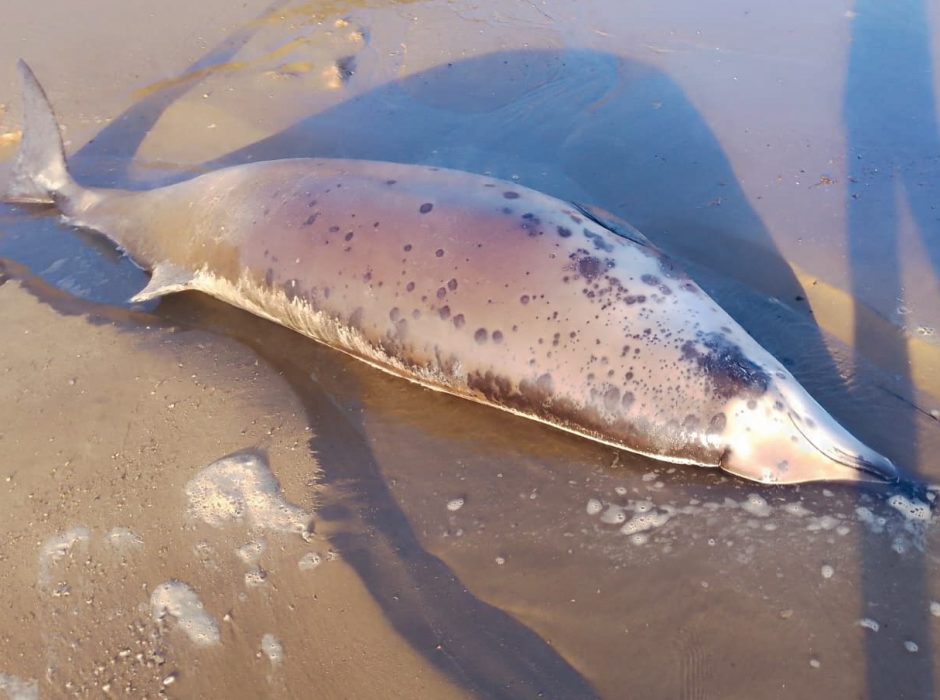
Marine Mammal Medics were tasked to the beach, finding two large stranded beaked whales which had died before their arrival. Both whales appeared to have been in good body condition, with large amounts of superficial grazing and injuries consistent with being stranded and washing in on the tide, though uncertainty surrounded their species identification.
The incident was reported to the Cetacean Strandings Investigation Programme, based at the Zoological Society of London. With assistance from North Norfolk District Council and Carl Bird Ltd, the whales were recovered from the beach so further examinations and necropsies could take place.
Initial reports from CSIP indicated that the whales were a juvenile male and a juvenile female, each measuring around 3.4 metres long. They were transported to a nearby site for post-mortem examinations, which found that the stomachs of both whales were empty, indicating they hadn’t fed for some time. Small numbers of parasites were also found but were not believed to be the cause of death. The examinations currently suggest that both whales live-stranded after moving away from their usual deep-water habitats, though some scientific evidence may be lost due to decomposition from the recent heatwave.
Their species, however, remains uncertain. Initially thought to be Sowerby’s beaked whales, their markings and some physical features don’t appear typical for what is known of the species. Skeletal measurements and genetic analysis will now be used to attempt to confirm the species of both whales.
Beaked whales are among the least understood of cetaceans, as they are highly adapted for life in deep offshore water and are rarely seen close to UK coastlines. Strandings of these elusive animals provide important opportunities to learn more about species which are otherwise extremely difficult to study.
BDMLR is grateful to the members of the public who reported the strandings, and to the CSIP team, Carl Bird Ltd and North Norfolk District Council for all their work in recovering and examining the whales.